Wood, Metal or Silicone: What Changes in a Cooking Spoon?
Compare a wood, metal or silicone cooking spoon by feel, flexibility and care, then choose one that suits your pans, recipes and washing routine.
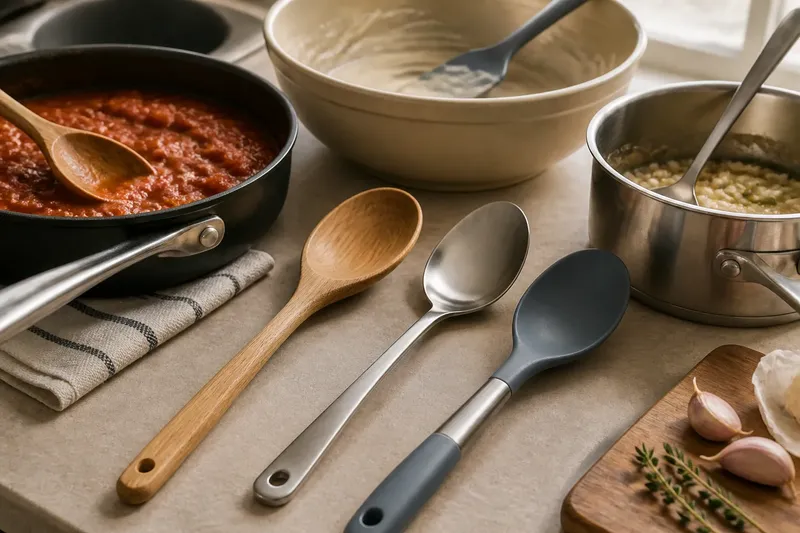
A cooking spoon’s material changes how it meets a pan, how firmly it moves food and how much care it needs. To choose a wood, metal or silicone cooking spoon, think about the jobs you do most: stirring sauce, scraping a bowl, turning food or serving from a pot.
Start with your pans and the food you cook
Check the cookware you use most often. A spoon that works well in a stainless-steel saucepan may mark a non-stick coating if its edge is hard. If you use both types of pan, decide whether one general-purpose spoon is enough or whether separate utensils would suit each surface better.
Consider the food, too. Loose soup and thin sauce are easy to stir with most spoons, while dough, mashed vegetables and thick risotto need more force. A broad, firm head can move dense food; a flexible edge can follow a bowl’s curve and gather soft mixtures.
Read the care instructions for both the utensil and the cookware. Follow the maker’s advice on washing, heat and surface compatibility where it applies.
Compare how wood, metal and silicone meet the pan
Wood feels firm but less hard against cookware than metal. Its edge suits many stirring and turning tasks, though it may not glide as smoothly as polished metal. The spoon’s shape and finish affect how it feels in use.
Metal is rigid, and a thin edge can slide under food or reach a narrow corner. That can help when stirring in an uncoated metal pan or lifting food from a roasting tray. The same hard edge may scratch some coated surfaces, so check your cookware guidance before using it there.
Silicone is softer, and its tip often bends enough to follow a mixing bowl or sweep a pan. That flexibility can make it less direct when moving a thick mixture. A reinforced handle or core may add firmness, so consider how the whole spoon bends rather than judging only its tip.
Choose a spoon shape that suits the job
A shallow, broad head can help with serving and turning food; a narrow head is easier to move around a small saucepan. A curved edge can gather food from a rounded bowl, while a flatter edge can sweep the bottom of a straight-sided pan.
For thick mixtures, look for a head that does not twist easily under pressure. For delicate pieces, a broader edge can provide more support. If you often scrape bowls, match the spoon’s edge to the bowl’s curve: a flexible silicone edge may collect more from the sides than a stiff wooden or metal head.
Say you regularly make thick tomato sauce in a non-stick saucepan and then scrape cake batter from a mixing bowl. In this invented situation, you try a wooden spoon for the sauce and find it comfortable to stir, but it leaves batter on the bowl; a metal spoon is a poor fit for the coated pan. A silicone spoon with a sturdy handle is the closer match for both jobs, though its tip may bend more than you want in the thickening sauce. The trade-off is clear: use one versatile spoon, or keep a firmer spoon for sauce and a flexible one for scraping.
Use these checks to compare spoons
- Check the cookware surface. If the pan has a coating, choose a utensil the cookware maker considers suitable; if that guidance is unclear, use a softer edge or ask the maker rather than risking a hard one.
- Check how the head moves thick food. If it twists when you press it gently against a bowl, choose a firmer design; if it stays controlled, it may suit dense mixtures.
- Check whether the edge follows a bowl. If it leaves a visible strip of mixture behind, choose a more flexible or better-shaped edge; if it follows the curve, it may suit scraping.
- Check the handle in your hand. If it feels slippery, narrow or awkward to balance, try another shape; if you can hold and angle it comfortably, keep it on your shortlist.
- Check the head-to-handle join. If food or moisture could collect in a gap, choose a simpler construction that is easier to clean; if the join is smooth and secure, check its care instructions before deciding.
- Check the washing instructions. If the utensil needs hand-washing you are unlikely to do, choose one whose care fits your routine; if its instructions suit your habits, it remains a practical option.
- Check where it will be stored. If the spoon’s size or hanging hole does not fit your drawer or rail, choose a shape that does; if it stores cleanly without pressing against sharp tools, it is easier to keep in regular use.
Choose a material that fits your usual jobs
Wood suits many everyday stirring tasks where a firm head is useful and a metal edge is unnecessary. Wash it promptly by hand, rinse away food and let it dry fully. Avoid prolonged soaking, and follow the maker’s care directions if they differ.
Metal can suit uncoated cookware and tasks that benefit from a rigid, thin edge. Check the head-to-handle join for residue, and store it so the edge does not repeatedly scrape a coated pan or delicate utensil.
Silicone can suit bowl scraping, soft mixtures and compatible coated cookware. Check that its handle feels secure when you press the head against food, and inspect the join for residue or damage. Washing and heat suitability depend on the utensil’s design, so read its care label.
A spoon’s thickness, head size and handle construction can make it feel quite different from another spoon made of the same material. If your tasks need conflicting qualities, two purpose-shaped spoons may be easier to use than one compromise.
How do you choose a cooking spoon?
Is a wooden spoon suitable for every pan?
Wood suits many stirring tasks, but suitability depends on the spoon’s condition and the cookware. Stop using it for food if it becomes rough, cracked or splintered.
Can you use a metal spoon in a non-stick pan?
Metal may mark or damage some coated surfaces. Choose a softer utensil unless the cookware maker says that metal is suitable.
Will a flexible silicone spoon move thick mixtures?
It can, particularly if its head and handle have enough support to resist twisting. For dense mixtures, choose a firmer design or keep a rigid spoon for that task.
What should you inspect on a silicone spoon?
Check that the head is securely attached, the handle feels comfortable and the edge has no cuts or rough damage. Read the care information instead of assuming all silicone utensils tolerate the same washing or heat.
Try the grip before choosing
If you can, hold the spoon before buying it. Wrap your fingers around the handle and angle the head as though you were stirring a saucepan. Notice whether the balance feels controlled: a broad head may feel cumbersome in a small pot, while a narrow handle may become uncomfortable during longer stirring.
For a useful starting pair, consider a wooden spoon for regular stirring and a silicone spoon for scraping bowls or working with suitable coated pans. Add a metal spoon if your cookware and tasks suit a firm edge. If you want only one, choose the cooking spoon material that fits your most frequent task, pan surfaces and washing habits; checking the grip and care instructions can help you avoid a utensil that is awkward to use or maintain.