Why a Kettle Spout Needs a Shape of Its Own
Kettle spout shape affects where water travels and how the pour starts and stops, helping you compare a kettle’s direction, control and form before choosing one.
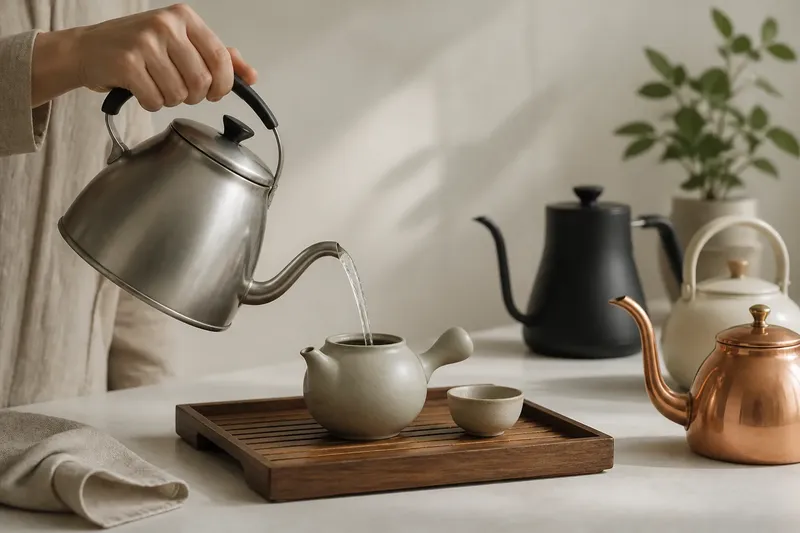
Kettle spout shape affects where water travels and how the pour starts and stops. Look beyond the silhouette: the outlet, channel and lip each help guide water from the kettle body towards a cup or pan.
A spout also has to work with the handle and the user’s movement. Direction is where the stream goes; control is how it changes as the kettle tilts. Appearance connects the spout to the rest of the object, but cannot substitute for a clear route for the water.
A spout gives water a route out of the kettle
The kettle body holds water, while the spout provides a channel to its opening. When the kettle tilts, water reaches that opening and passes over its lower edge. The outlet’s position and angle influence where the stream begins and where it travels.
A broad opening may let water leave across a wider area; a narrower channel may concentrate it. A projecting tip can separate the outlet from the body. These are design tendencies, not fixed outcomes: the water level, tilt and channel all affect the pour.
Direction and control are separate design tasks
Direction concerns aiming the stream at the intended vessel. The spout’s projection and outlet angle help establish where the stream begins in relation to the handle and body, while the handle affects how the user can tilt the kettle.
Control concerns how the flow responds to that movement. The user begins the pour, adjusts the tilt to change the flow, then brings the kettle upright. A spout that responds gradually can make those adjustments easier to read; a flow that changes abruptly may require the user to correct their movement.
A generous opening may suit a faster pour but be less suited to a fine stream. A restricted channel may focus the flow but take longer to fill a larger vessel. The right balance depends on the intended use, rather than on a single shape being best for every kettle.
Imagine a person pouring from a full kettle into a narrow-necked teapot. The starting point is a full kettle and a small target opening; the person tilts it, sees a stronger flow arrive sooner than expected, and reduces the tilt. If the channel delivers water more gradually, the observable result would be a stream that is easier to adjust, though it may take longer to fill the teapot.
The lip helps determine where water leaves
The lip is the boundary at the end of the spout. Water may follow the surface before separating from the kettle, so the edge profile can influence where the stream breaks away. A distinct edge can give water a clearer departure point; a rounded or uneven edge may let it cling or spread.
If water travels along the underside after the main stream stops, it may leave a drip on the kettle or worktop. The edge is only one part of that behaviour: the channel and the way the user brings the kettle upright also matter.
A spout should be considered at the start, during the main pour and as it stops. A slow pour can make water clinging to the underside easier to notice than a quick one. The lip also needs to suit the kettle’s material, construction and care requirements; check the maker’s instructions rather than assuming a particular edge is durable or easy to clean.
The outer form should support the water channel
A spout may blend into the kettle body, project from it or taper towards the outlet. Each choice changes the silhouette and the channel that carries water. A long projection may make the outlet easier to place above a cup, while a compact form may sit more quietly within the outline.
Appearance can suggest precision, but the channel and lip have to support the impression. When comparing kettles in a shop or product images, look at the outlet in relation to the handle and body. Then consider whether the form appears to give water a clear route without making the spout visually dominate the kettle.
Questions to ask about kettle spout shape?
How does the spout affect pouring direction?
Look at where the outlet points in relation to the handle and body. A useful arrangement directs the stream towards the intended vessel without requiring an awkward tilt.
Why might a kettle drip after pouring?
Water can cling to the lip or underside instead of separating cleanly. The edge, channel and movement that brings the kettle upright can all contribute.
Is a narrow spout always easier to control?
No. A narrower outlet may concentrate the stream, but the user’s tilt and the channel’s response also shape the flow. Consider whether you usually need a fine pour or a quicker one.
How can appearance and function be balanced?
Check that the channel leads clearly to the outlet, then consider how the spout’s outer form sits with the body and handle. A visually restrained shape can still direct water well if its opening and lip provide a clear route.
Compare the whole pour before choosing
When you can inspect a kettle, use these observations to decide what to examine next:
- Check where the outlet points; if it appears to direct water away from the body towards your usual vessel, keep it on your shortlist, and if not, compare a different outlet angle.
- Check how the handle sits in relation to the spout; if the intended tilt looks comfortable for your grip, consider the kettle further, and if not, try another handle and spout arrangement.
- Check whether the channel visibly narrows towards the tip; if you want a focused stream, compare it with a broader outlet, and if you need a faster flow, consider a less restricted opening.
- Check the lip and underside for a clear edge; if the edge looks uneven or likely to catch water, inspect another design or seek a pouring demonstration, and if it appears well defined, continue assessing the rest of the kettle.
- Check whether the spout’s projection suits your target vessel; if it reaches the intended position without an awkward tilt, keep comparing, and if it does not, look for a different projection or outlet angle.
- Check the maker’s care instructions for the spout material; if cleaning or maintenance does not suit your routine, choose another option, and if the instructions are clear and practical for you, include that in your decision.
These observations do not predict an exact pour from appearance alone. If the shop permits a demonstration, watch how the stream begins, changes and stops; otherwise, use product information and the maker’s care guidance to resolve questions about use and maintenance.
Kettle spout shape is most useful to judge as a sequence: water reaches the opening, leaves the lip, travels towards its target and stops. A pointed tip alone cannot tell you how that sequence will feel. Compare the channel, outlet and handle together, and let the kettle’s intended use guide which trade-off matters most.