How a Foldable Paper Lamp Shade Uses Creases to Shape Light
See how a foldable paper lamp shade uses creases to create structure and organise light, and learn what to observe in its shape, pattern and material.
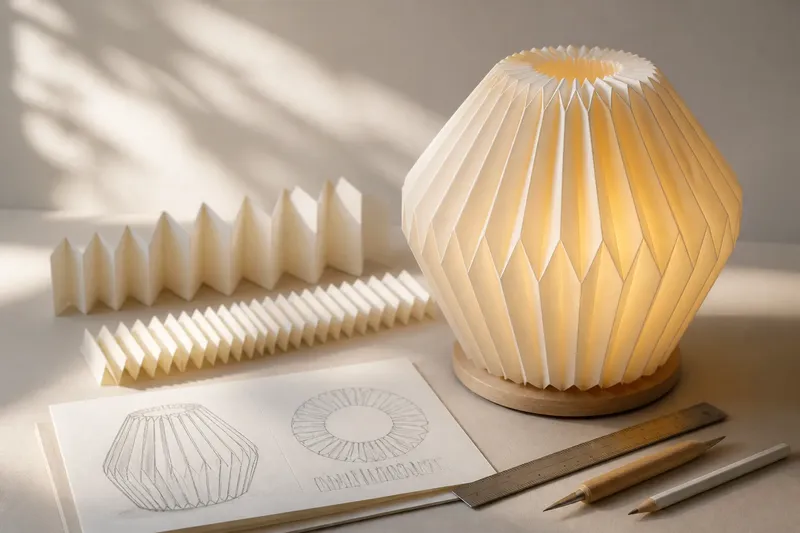
A foldable paper lamp shade holds its shape through a network of ridges and valleys, not a moulded shell. That makes its design easy to read: each crease helps organise the paper, guides the shade as it opens, and changes how light falls across the surface.
This article focuses on the object’s visible design logic rather than claiming a particular origin or historical sequence. Without a named designer, date or documented source, it is more useful to examine what the folds do than to assign the shade a place in a broad history of household materials.
Creases give a flat sheet a three-dimensional form
A flat sheet bends readily, but a series of ridges makes it resist bending across the raised lines. The folded paper can still open and collapse, while its geometry helps it retain a recognisable volume.
Different crease arrangements guide the movement in different ways. Parallel pleats tend to open along one direction; radial folds gather towards an opening; crossing folds break the surface into smaller facets. The pattern determines where the paper bends and where it holds its form.
Each fold also creates a narrow plane. A ridge catches light at a different angle from the valley beside it, giving the shade a changing appearance as someone moves around it. From a distance the pattern may look regular; close up, small differences in the creases become more visible.
Foldable paper lamp shade design depends on spacing and edges
In a foldable paper lamp shade, the crease is both a structural line and a visual cue. A crisp crease makes the pattern easy to follow as the sheet opens, while a softened crease gives the surface a gentler transition and a less sharply defined profile.
Even spacing creates a steady visual rhythm. If pleats gather tightly in one area and spread out in another, the pattern seems to accelerate or relax, drawing attention towards an opening, rim or broad part of the shade without adding a separate ornament.
The edge completes that decision. An exposed paper edge can look light and direct; a folded hem gives the perimeter more body and marks where the form ends. Look at whether the edge continues the crease pattern or sets a distinct boundary.
Ridges and valleys make light visible as a pattern
A pleated paper shade does more than block light. Its angled ridges and valleys receive and show illumination differently, creating alternating bands of brightness and shade that can make the surface appear more sculptural.
The paper changes the effect. A translucent sheet allows a broad glow through its surface, while a more opaque one makes the light depend more on openings and reflected illumination. Printed or coloured paper may read one way in daylight and another when illuminated from within.
The shade and light source must be considered together. An unlit surface can reveal every crease when illuminated, but ordinary paper should not be assumed suitable for use around a working fitting. Follow the lamp and material maker’s instructions, and consult a qualified professional if the safe arrangement is unclear.
Compare fold patterns with a simple paper study
You can examine form without building a working lamp. Use two paper strips, a ruler and a blunt scoring tool; keep the samples separate from any lamp or heat source. This lets you compare fold spacing and stiffness without treating the paper as a lighting component.
- Check the first strip’s pleats: Fold it into evenly spaced accordion pleats and open it partway. If it holds a recognisable shape, compare that position with the fully opened form; if it springs back, mark where the folds lose their definition and try a different spacing.
- Check the second strip’s spacing: Make its pleats visibly wider than those on the first strip. If the wider pattern looks less crowded when open, use that spacing for a calmer rhythm; if the surface looks too sparse, choose a spacing between the two samples.
- Check how the paper takes a crease: Fold a sample of softer paper and one of stiffer paper with the same pattern. If the softer sheet loses its ridges, favour a firmer sheet for a study of crisp form; if the stiffer sheet resists opening, choose the softer sheet to study movement.
- Check the fold pattern from different angles: View each sample from the side and below under ordinary room light, keeping it away from the lamp. If alternating ridges and valleys are easy to distinguish, the pattern reads clearly; if not, change the fold depth or spacing in the next paper study.
- Check the top and rim in a sketch: Draw a simple shade outline and mark where the folds gather, spread or stop. If the marks lead the eye towards the opening or rim, keep that arrangement; if they compete with the outline, simplify the pattern near the edge.
- Check whether the edge interrupts the rhythm: Compare an exposed edge with a folded paper hem on a spare sample. If the hem makes the boundary clearer, show it in the design sketch; if it draws too much attention, keep the edge visually quieter.
Say you have two strips cut from ordinary drawing paper: one folded into close pleats and the other into wider pleats. You open both halfway, then fully, and observe that the close pleats look busy while the wider ones leave more open surface. You view them under room light without attaching them to a fitting; the wider sample’s broader ridges and valleys are easier to distinguish, so you choose it for a sketch intended to show a calm, regular pattern. That choice favours visual clarity over a dense surface.
What do readers ask about foldable paper lamp shades?
What does a fold add to a paper shade?
A fold stiffens a flexible sheet along a chosen line and helps organise it into a three-dimensional form. Repeated folds also create a surface pattern that shifts with the viewing angle.
How do pleats change the appearance of light?
Pleats place neighbouring parts of the paper at different angles, so ridges and valleys receive and show light differently. This gives the surface a more patterned appearance than a smooth sheet would have.
Does every fold pattern make a shade stronger?
No pattern is automatically stronger in every direction. The paper, crease depth, spacing and overall shape all affect how the folded form behaves, so consider them together.
Can paper sit directly around a lamp?
Do not assume ordinary paper is suitable for a working light fitting. Follow the lamp and material instructions, and ask a qualified professional if you cannot determine whether a particular arrangement is safe.
Trace the crease to understand the design
A folded shade can be read like a drawing made to stand up. Crease lines show how the sheet is organised, while the planes between them catch light; this helps separate structural choices from surface decoration.
When comparing designs, trace a fold from the top opening towards the rim. Notice where it begins, whether it remains straight, and how it meets neighbouring folds. These details reveal whether the pattern follows a consistent system or changes direction to shape the outline.
The useful design lesson in a foldable paper lamp shade is how a small change to a flat sheet can organise form, movement and visual rhythm at once. Follow the creases from opening to edge, and you can see how the shade’s structure and appearance are made by the same decisions.